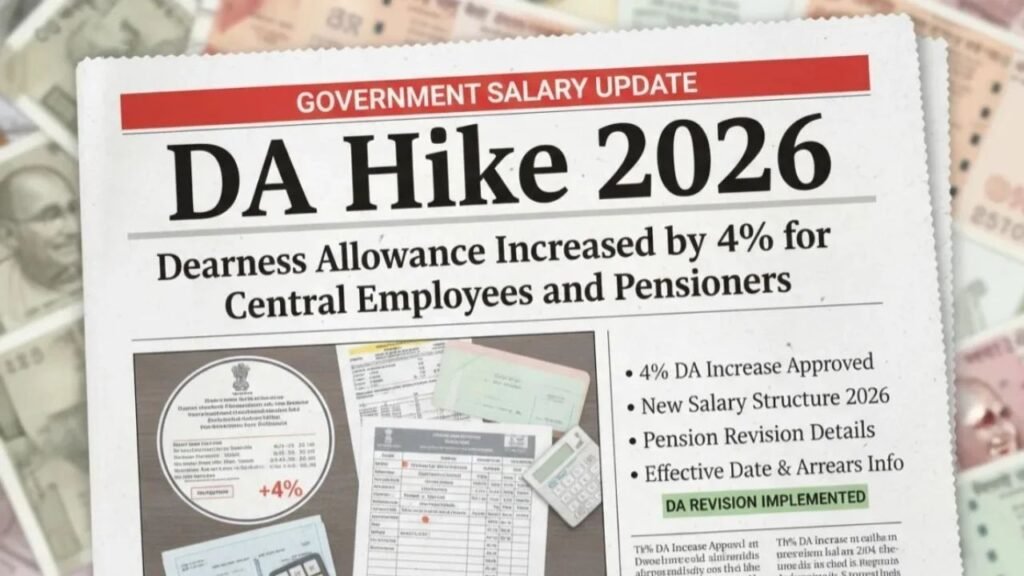
In 2026, the government announced a 4% increase in Dearness Allowance (DA) for central government employees and Dearness Relief (DR) for pensioners. This decision brings some financial relief to millions of families who depend on fixed salaries or pensions. Over the past few years, the cost of everyday items such as vegetables, fuel, school fees, and medicines has increased a lot. Because of this, many households have felt pressure on their monthly budgets. The DA system helps government employees deal with rising prices. Whenever inflation increases, the government reviews the allowance and adjusts it to maintain the purchasing power of salaries and pensions. That is why government jobs are often seen as stable and financially secure. DA Hike 2026: Dearness Allowance Increased by 4% for Central Employees and Pensioners
2. What the 4% Increase Means for Your Monthly Income
At first glance, a 4% increase may sound small. However, since DA is calculated as a percentage of the basic salary, the actual benefit can be quite noticeable. Every employee receives a different amount depending on their pay level. For example, if someone has a basic salary of ₹50,000, a 4% increase means around ₹2,000 more every month. This extra money can help with daily expenses, savings, or small family needs. Pensioners will also benefit from this increase through Dearness Relief, which works in the same way as DA. For many retired people, even a small monthly increase can help manage medical and household costs.
3. How Dearness Allowance Is Calculated
The increase in DA is not random. It is based on a formula used by the government. Officials track a price indicator called the All India Consumer Price Index (AICPI). This index measures the changes in the prices of common goods and services that people buy regularly. When the index shows that inflation is rising over a period of time, the government adjusts DA to match those changes. This helps ensure that employees and pensioners can still afford essential items even when prices go up. In simple terms, DA acts like a protection system that helps keep incomes stable during times of inflation.

4. Additional Benefits After the DA Increase
The DA hike does more than just increase monthly income. In some cases, the new rate is applied from an earlier date. When this happens, employees and pensioners receive arrears, which is a lump-sum payment covering the difference for past months. This extra money can be very helpful. Some families may use it to pay school fees, clear small debts, or buy important household items. However, it is also important to remember that DA is part of total income and is taxable. Because of this, it may be a good time to review tax-saving investments such as PPF, insurance plans, or other savings options.
5. DA Hike 2026 – Key Information at a Glance
| Category | Approx. Basic Pay / Pension | Previous DA (56%) | New DA (60%) | Monthly Increase | Annual Increase |
|---|---|---|---|---|---|
| Entry-Level Employee | ₹25,000 | ₹14,000 | ₹15,000 | ₹1,000 | ₹12,000 |
| Mid-Level Employee | ₹55,000 | ₹30,800 | ₹33,000 | ₹2,200 | ₹26,400 |
| Senior Employee | ₹1,10,000 | ₹61,600 | ₹66,000 | ₹4,400 | ₹52,800 |
| Pensioner (Mid-Level) | ₹27,500 | ₹15,400 | ₹16,500 | ₹1,100 | ₹13,200 |
| Pensioner (Senior Level) | ₹55,000 | ₹30,800 | ₹33,000 | ₹2,200 | ₹26,400 |
Note: These figures are examples to explain the increase. Actual amounts depend on individual basic pay.
6. What the Future May Hold: Discussion About the 8th Pay Commission
The current salary structure is based on the 7th Pay Commission, which was introduced in 2016. Since then, DA has been revised many times to adjust salaries according to inflation. Over time, the percentage of DA keeps increasing. When DA becomes very high, the government may decide to create a new Pay Commission. Its job is to review salaries and sometimes merge DA into the basic pay. Because of this, many experts and employee groups are already discussing the possibility of an 8th Pay Commission in the future. If it happens, it could bring larger changes to salary and pension structures.

Helpful Tips for Employees and Pensioners
- Update your monthly budget after the DA increase
- Save a portion of the extra income for the future
- Consider tax-saving investments like PPF or ELSS
- Use arrears wisely instead of spending it all at once
- Build an emergency fund or health insurance cover
Frequently Asked Questions (FAQs)
1. What is the new DA rate in 2026?
The government has increased Dearness Allowance by 4%, taking the total DA to about 60% of basic pay.
2. Who will receive this DA increase?
All central government employees and pensioners will receive the benefit of this increase.
3. How is DA calculated?
DA is calculated using the All India Consumer Price Index (AICPI), which tracks changes in the cost of essential goods and services.

4. Will pensioners also benefit from the increase?
Yes. Pensioners receive Dearness Relief (DR), which increases by the same percentage as DA.
5. Is Dearness Allowance taxable?
Yes, DA is considered part of salary income and is fully taxable according to the applicable tax slab.
6. Will employees receive arrears?
If the new DA rate is applied from an earlier date, employees and pensioners may receive arrears for the previous months.